How to Choose Stand Up Pouches with Spouts for Wholesale
Choosing stand-up pouches with spouts for wholesale is not just a matter of picking an attractive shape. The pouch must suit the product, filling process, storage conditions, and customer’s daily use. A thick smoothie may need a wider opening than a thin drink. A pouch that stands neatly on a sample shelf may still tip when filled or crease during transport. Small details matter.
Walter Landor, a pioneer in brand and package design, is often quoted as saying, “Products are made in the factory, but brands are created in the mind.” That idea applies here: the spout, pouch material, and printed surface all shape how buyers experience a product. For wholesale orders, test samples with the actual contents, check seal consistency, and compare opening sizes before committing to a large run. Ask suppliers for material specifications and clear production tolerances. Then test filled pouches for leaks and shelf stability. It takes time.
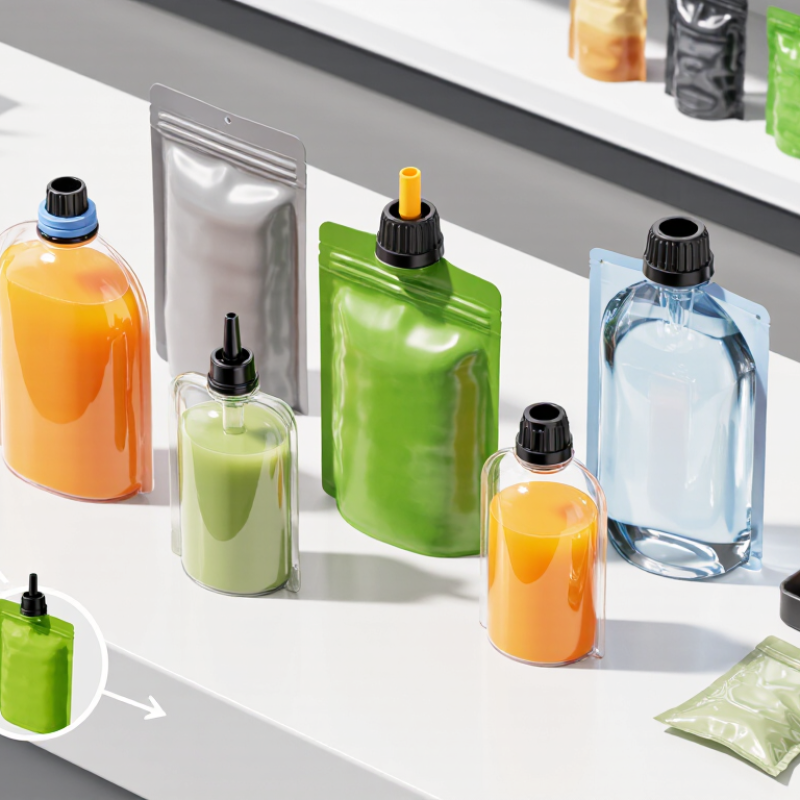
This guide explores how to compare Stand-Up With Spout options by capacity, film structure, fitment, printing, and supplier capability. It also considers trade-offs that are easy to overlook, such as balancing a wider spout against pouring control. There is no perfect pouch for every product. A careful sample trial can reveal more than a polished product sheet—and it may expose a choice that needs rethinking.
Define Fill Volume and Viscosity; Screen 8–16 mm Spout Openings
How to Choose Stand Up Pouches with Spouts for Wholesale
Before requesting wholesale quotes, define the fill volume and your product’s viscosity. A 250 ml sauce and a 500 ml smoothie need different pouch dimensions, headspace, and pouring behavior. Record fill weight too; equal volumes can weigh differently. Thick products, such as yogurt or concentrated purée, may flow slowly through narrow spouts. Thin liquids drain quickly and can splash. Test with your actual product, not water alone.
Screen spout openings from 8–16 mm, then match the diameter to flow and particle size. An 8 mm opening may work for thinner liquids but clog with pulp or seeds. Openings near 12–16 mm can help thicker contents pour more easily, though they may spill faster. Check the cap fit, pouring angle, and squeeze comfort. Test filled samples at room temperature and at expected storage temperatures. Results can differ.
Tips: Ask for several samples before approving a bulk order. Pour slowly, then squeeze gently; note drips, clogging, and leftover product. A bench test can still miss real handling habits, so leave room to reassess.
How to Choose Stand Up Pouches with Spouts for Wholesale – Define Fill Volume and Viscosity; Screen 8–16 mm Spout Openings
| Product Type |
Typical Fill Volume |
Approximate Viscosity at 20–25°C |
Spout Opening to Screen |
Selection Considerations |
| Water and thin beverages |
100–500 mL |
About 1–5 mPa·s |
8–10 mm |
A smaller opening can support controlled pouring for low-viscosity liquids. Check that the cap and seal are compatible with the filling and dispensing process. |
| Juice and flavored drinks |
150–500 mL |
About 1–20 mPa·s |
8–10 mm |
For pulp or suspended pieces, assess the particle size as well as the liquid viscosity; a narrow opening may clog. |
| Edible oils and pourable dressings |
250–1,000 mL |
About 30–150 mPa·s |
10–12 mm |
Test pouring speed and residual product in the pouch. Actual viscosity varies by oil or formulation and temperature. |
| Syrups and pourable sauces |
250–1,000 mL |
About 100–1,500 mPa·s |
12–14 mm |
A wider opening can make dispensing easier, but confirm that the closure provides the required leak resistance during storage and transport. |
| Smoothies and drinkable yogurt |
150–500 mL |
About 500–3,000 mPa·s |
12–16 mm |
Check flow under realistic squeezing conditions. Formulations with fruit pieces may require a larger opening or a different dispensing format. |
| Thick purées and concentrated pastes |
100–500 mL |
About 1,000–10,000 mPa·s |
14–16 mm |
Conduct filling and dispensing trials with the actual product. High viscosity, particulates, and temperature changes can significantly affect flow. |
Screening note: These are indicative starting ranges, not universal specifications. Viscosity depends on formulation, temperature, and measurement method. Confirm the spout’s internal opening, pouch dimensions, filling equipment compatibility, seal integrity, and user dispensing performance with production samples before placing a wholesale order.
Compare Barrier Films Using ASTM D3985 OTR and ASTM F1249 WVTR Tests
A spouted pouch must protect its contents through storage, transport, and repeated squeezing.
The Flexible Packaging Association’s 2023 State of the U.S. Flexible Packaging Industry report estimated U.S. sales at about $42.9 billion in 2022. That scale makes clear specifications valuable, but market size alone cannot predict shelf life. Check the actual laminate and finished-pouch performance.
Compare candidate films using ASTM D3985 for oxygen transmission rate (OTR) and ASTM F1249 for water vapor transmission rate (WVTR). Record results in cc/m²·day and g/m²·day, alongside test temperature and humidity.
Conditions matter. A low OTR measured under one humidity may not match a supplier’s result under another. Ask for reports on the complete laminate, not just a single layer, and note whether samples were tested before or after flexing.
The ASTM methods define measurement procedures; they do not set a universal pass limit. Set limits from the product’s sensitivity and intended shelf life.
A practical trial might compare a standard barrier laminate with a metallized or foil-based structure, then test filled pouches for seal integrity and spout-area leaks.
Small details count. The cap, fitment, and seal can undermine an otherwise strong film.
Assess Laminate Thickness with 80–150 μm Film Options
For wholesale stand-up pouches with spouts, treat 80–150 μm as a practical comparison range, not a universal quality scale. The figure usually describes the combined film laminate. Its performance also depends on the material layers, pouch dimensions, seal design, and filling conditions. A thicker film can add puncture resistance, but it may also increase material use and affect how smoothly pouches run on packing equipment.
An 80–100 μm structure may suit lighter products and careful handling, while heavier fills or rougher distribution may call for a thicker option. These are starting points, not guarantees. A common planning mistake is choosing by micron count alone. Oxygen and moisture protection depend on the laminate structure, not simply its thickness. Check that the spout and surrounding seals hold up under filling, storage, and transport. Small leaks are costly.
Ask for samples in the intended size and fill them with the actual product. Then check seal integrity, handling, and compatibility with the filling line. Test before scaling. It is tempting to choose the heaviest film for reassurance, but that can add cost without solving the real weakness. There is no perfect number; document test results and adjust the specification when field feedback reveals a problem.
Verify Food-Contact Compliance with FDA 21 CFR 177.1520 or EU 10/2011
For wholesale orders, assess a spouted stand-up pouch as a layered food-contact system, not simply a film bag. The spout, sealant, tie layers, and coatings may use different materials. Request the material specification, intended food types, fill temperature, and contact duration.
Small details matter. A pouch for hot-fill sauce may need different evidence from one for dry snacks.
FDA 21 CFR 177.1520 covers specified olefin polymers; it does not certify an entire multilayer pouch by itself. For EU sales, Regulation (EU) No 10/2011 sets a general overall migration limit of 10 mg per square decimeter, subject to applicable conditions and exceptions.
Ask suppliers for a food-contact declaration and migration test reports matching the exact pouch and spout construction. The Flexible Packaging Association’s 2023 State of the U.S. Flexible Packaging Industry report estimated 2022 sales at $42.9 billion. That market scale is not proof of compliance.
Check the paperwork, not just the product sample. I would also verify that test conditions reflect the real food and filling process; this step is easy to overlook.
Compare Wholesale MOQ, Unit Cost, Lead Time, and ISO 2859-1 Sampling Terms
When comparing wholesale stand-up pouches with spouts, request the MOQ, unit price, and lead time in one written quote. Lower MOQs often mean higher unit costs because setup and material expenses are spread across fewer pouches. Ask whether the quote includes the spout, printing, and packaging for shipment. The Flexible Packaging Association’s 2024 State of the U.S. Flexible Packaging Industry report estimated 2023 sales at $42.9 billion, reflecting a large, varied sector—not a guarantee of any supplier’s capacity or pricing. Check the quote against your pouch size, film structure, fill volume, and order quantity.
Lead time needs a clear starting point. Is it counted from deposit, approved artwork, or final proof? Ask for separate estimates for sampling, production, and shipping; a fast factory schedule can still mean a slow delivery. For incoming inspection, specify ISO 2859-1 terms in the purchase agreement: lot size, inspection level, AQL, and normal or tightened inspection. AQL is a sampling rule, not a promise of defect-free pouches. Be precise here. The standard’s sample plan helps both parties interpret acceptance consistently, but it cannot replace checks on spout fit, seal strength, and leak performance.
Tips: Request a pilot run before committing to a large MOQ. Test filled pouches upright, then lay them on their sides. Record leaks and seal defects. Slightly inconvenient, but useful. Compare quotes using the same specifications and delivery terms.
How to Choose Stand Up Pouches with Spouts for Wholesale
Compare MOQ, unit cost, lead time, and inspection terms. The chart shows ISO 2859-1 sample sizes for General Inspection Level II, normal single sampling.
For the lot-size ranges shown, the corresponding sample sizes are 80, 125, 200, and 315 units. These figures assume General Inspection Level II and normal single sampling; the selected AQL affects acceptance and rejection limits, not the sample size. MOQ, unit price, and lead time vary by supplier and pouch specifications, so compare written quotes on the same basis.